
House garages and private condo garages
Epoxy Garage Flooring in Miami, FL
A sealed garage floor that shrugs off sand, spills and storm water and does not yellow in the strip of sun by the door.
- Free estimates done in person, with the floor measured on site
- Every slab moisture-tested before the first coat
- Written quotes that spell out prep, coats and total
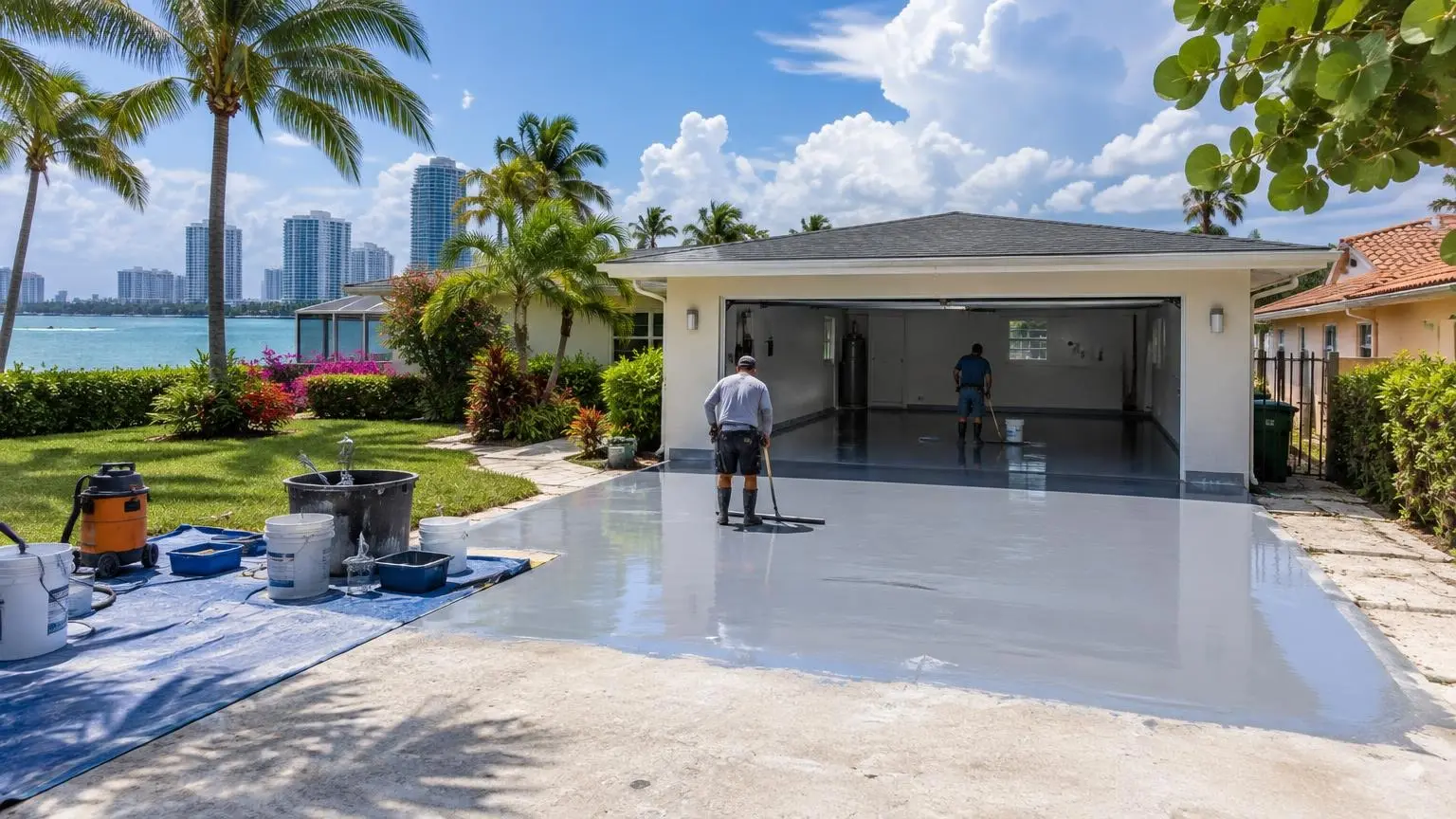
Garage Floors That Hold Up in Miami
Epoxy garage flooring is the job Miami homeowners call us about most. Here a garage seldom holds only a car. It also stores bikes, pool supplies, hurricane shutters, the generator, a freezer and often the laundry. The door stays up for long stretches, summer storms blow rain under it, and the air inside is humid for most of the year. A proper garage floor coating seals the concrete so all of that stays on top, where you can sweep it, mop it or hose it away.
Why bare garage concrete looks worse every year
Concrete soaks things up. Oil, brake fluid, pool chlorine, fertilizer, and wet sand from beach days work into the pores and leave dark stains that will not scrub out. Untreated concrete also sheds a fine dust that comes back soon after you sweep. In humid weather, damp spots and rust rings show up under anything metal left on the floor. Many Miami garages also carry an old painted floor or a store-kit garage floor epoxy that is now peeling in the tire paths.
Signs it is time to coat
- Stains that have soaked in and will not come out
- Dust that returns a day or two after sweeping
- Paint or kit coating lifting where the tires sit
- Cracks, broken joint edges or a dip by the door where water puddles
- A faded, chalky band just inside the door where sun and rain hit
- Rust marks from tools, bikes or shutters stored on the floor
Moisture comes first
Miami sits on porous limestone with the water table close to the surface, and summer dew points stay above 70 degrees. Both matter for a garage floor. Vapor rising through the slab is a leading cause of blistered garage coatings. We test the slab at the estimate, and when it shows vapor, we use a primer built for it. On install day we read the air and slab temperature before each coat so we are not laying resin onto a surface that is about to sweat.
Sun, heat and hot tires
Under HomeGuide's ratings, standard epoxy earns only poor to fair marks for UV resistance, and in a garage that shows up as yellowing wherever the sun reaches. So every garage we coat is finished with polyaspartic, which HomeGuide scores as excellent for UV. Heat adds a second problem, known as hot tire pickup. Tires soften on hot pavement, grab a thin coating as they cool overnight, and tear it loose when you back out. The answer is a thick system bonded to ground concrete with a hard topcoat over it.
Prep is where the money goes
Most failed garage floors never bonded properly. Store kits depend on acid etching, which freshens the surface yet leaves oil, old sealer and weak concrete in place. Our crews run diamond grinders across the entire slab, right to the edges, then vacuum, clean out oil stains, fill cracks and chipped joints, and rebuild spalled edges. On older slabs from the 1950s through the 1970s, common in nearby cities like Miami Springs and Hialeah, the grinder often has to cut through two or three layers of paint first.
Condo and tower garages
In a building, the work happens in a shared space. We plan around building approvals, quiet hours, elevator or ramp access and ventilation, and we keep grinding dust contained with vacuum-attached equipment. Private garages and storage rooms in towers can be coated, but the building usually has to agree first.
Choosing a look for the garage
Most Miami homeowners pick a full flake broadcast for the garage because it hides sand, leaf litter and tire dust between cleanings, and the chips add grip when rain blows under the door. A solid base color with only a sprinkle of chips reads cleaner and more modern, but dust shows sooner. Lighter blends brighten a garage with no windows and show tire marks less. Very dark floors look sharp but warm up when the afternoon sun comes in. Whatever the color, the clear topcoat is what you actually walk and drive on, so that is where we spend the most care.
Living with a coated garage in this climate
- Blow out or sweep sand often, since grit under tires slowly dulls any finish.
- Rinse pool chlorine, fertilizer and salt water off promptly.
- Clean with a pH-neutral product, never acid cleaners or strong degreasers.
- Put a plywood pad or a puck under kickstands, jack stands and generator feet to spread the weight and keep the coating from denting.
- Store hurricane shutters on a rack or blocks so their edges do not gouge the floor when they are moved.
- After a storm pushes water and silt in, hose it out before it dries.
A garage floor that is cared for like this keeps its color and gloss far longer, and small scuffs can usually be fixed with a light recoat of the topcoat instead of a full redo.
What a Garage Job Includes
A complete garage floor coating runs wall to wall, from the threshold at the door to the rear of the garage.
Diamond grinding
Grinding across the whole floor and along its edges to strip paint, sealer, stains and weak surface concrete.
Moisture test and primer
A slab test at the estimate, and a moisture-tolerant primer whenever the readings call for it.
Crack, joint and edge repair
Cracks, control joints and chipped edges filled to give one continuous finished surface.
Base coat, color or flake
A bonded epoxy base in solid color or with a flake broadcast.
Polyaspartic topcoat
A clear, UV-stable top layer that resists yellowing and hot tire pickup.
Steps and stem walls
On request, the coating can continue up garage steps and onto the low concrete curb at the base of the walls.
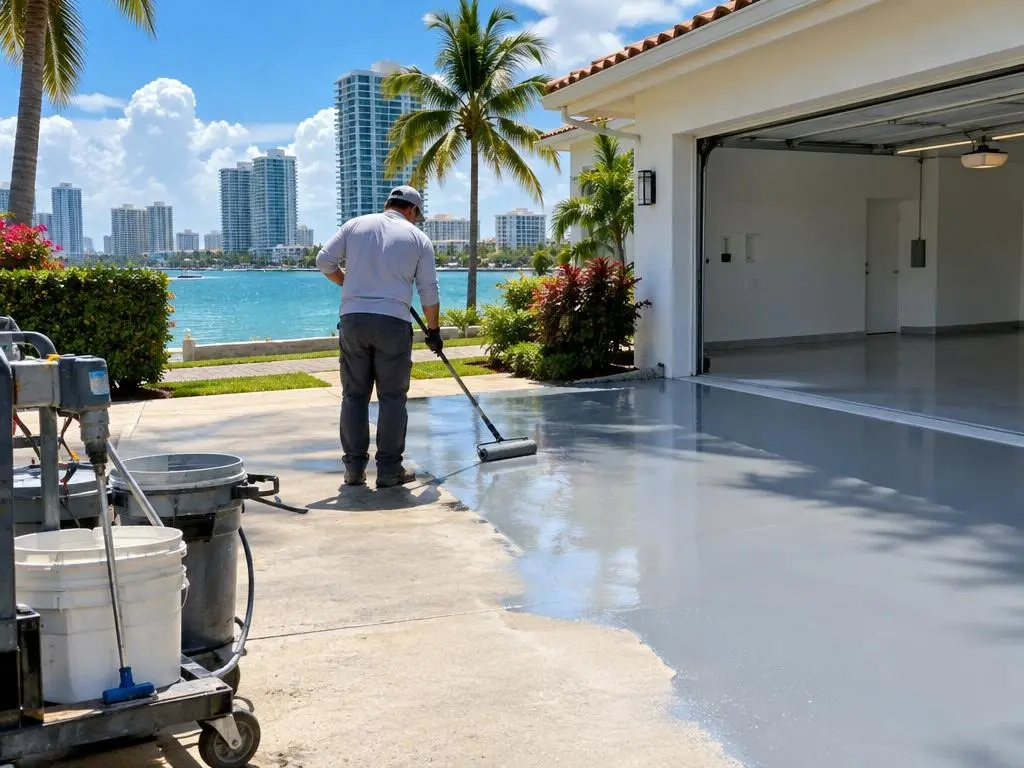
Published Garage Floor Coating Costs
| Garage or item | Typical range | Source |
|---|---|---|
| Installed epoxy, per sq ft | $4 to $10 | HomeGuide |
| One-car garage, epoxy | $1,200 to $3,900 | HomeGuide |
| Two-car garage, epoxy | $1,600 to $5,800 | HomeGuide |
| Three-car garage, epoxy | $2,300 to $8,600 | HomeGuide |
| Two-car garage, polyaspartic | $2,000 to $6,900 | HomeGuide |
| Crack and chip patching | $25 to $250 | This Old House |
Treat these as national figures, not Miami quotes. Crack repair, stripping an old coating, a moisture primer and the finish you pick can each push the number up or down. What you actually pay is the total on your written estimate.
How a Garage Job Runs
1. Estimate and slab test
Measurements, a moisture test and notes on stains, cracks and any old coating.
2. Written quote
A written quote listing the system, every coat, the prep work and a single total.
3. Grind and repair
We diamond grind, vacuum and degrease the floor, then patch it.
4. Coat
Primer if needed, base coat, color or flake, then a polyaspartic topcoat, applied when the readings are right.
5. Cure and return
We tell you when it is safe to walk on, when your things can go back in and when the car can park, based on the product and the conditions that day.
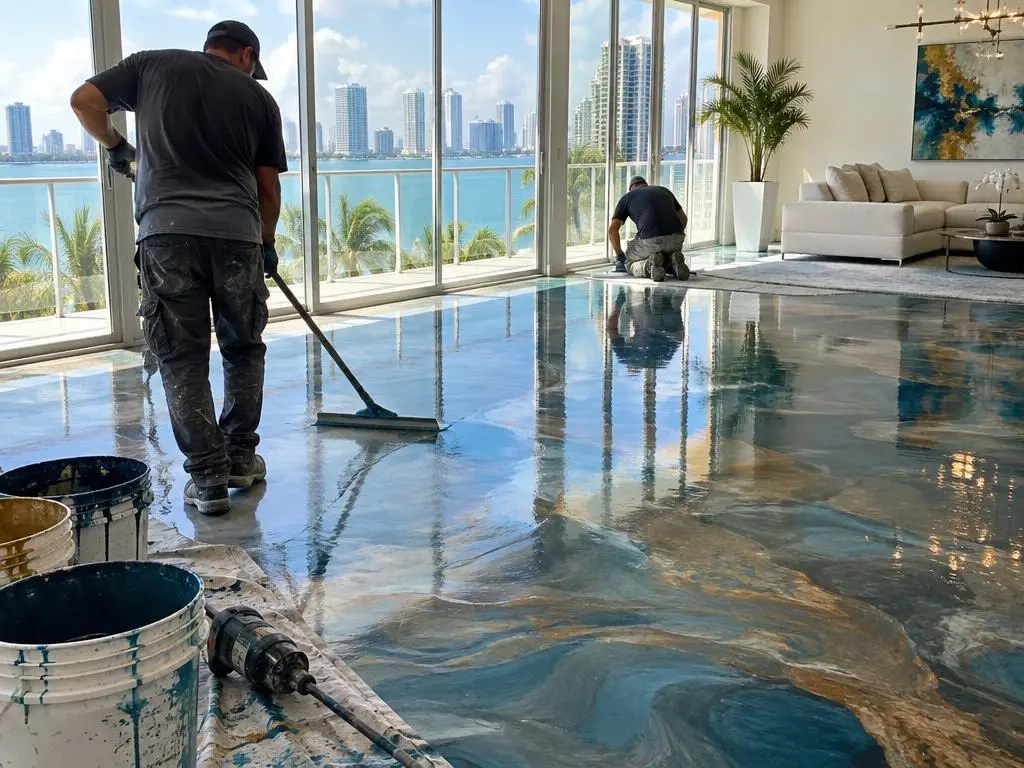
Why Choose Us for Epoxy Garage Flooring
Full grind, not an etch
A diamond grinder opens up the concrete so the coating grips sound material.
Topcoat chosen for the sun
Every garage gets a UV-stable topcoat, not bare epoxy.
Readings before each coat
We check humidity and slab temperature so moisture is not trapped under the floor.
Epoxy Garage Flooring Questions
How much does an epoxy garage floor cost in Miami?
HomeGuide's national figures are about $1,600 to $5,800 for a two-car garage in epoxy and $2,000 to $6,900 in polyaspartic. Removing old paint, filling cracks and adding a moisture primer change the total. Once we have measured and tested your floor, you get a written price.
Is a garage floor coating worth it if my garage floods in storms?
A coating will not keep water out, but it stops the concrete from soaking up water, silt and anything carried in with it, so cleanup is faster. If water comes in often, it is worth fixing the threshold or drainage as well. We look at that during the estimate.
Why do DIY garage floor epoxy kits peel?
Most kits are thin, water-based products over an acid-etched floor. Etching does not remove oil, sealer or weak surface concrete, and many kits go on without a moisture test. In a humid climate, those shortcuts usually show up as peeling in the tire paths.
Can I use the garage the same day?
Not for parking. HomeGuide advises keeping cars off epoxy for 2 to 7 days and says polyaspartic can take heavy vehicles after roughly 24 to 48 hours. Walking on it is usually fine sooner. You get exact times from us before we leave.
Will the floor be slippery when wet?
A smooth, glossy finish can be. Flake broadcast floors give more grip, and a fine anti-slip additive can also go into the topcoat. For garages that get rain under the door, we usually suggest one of those two.
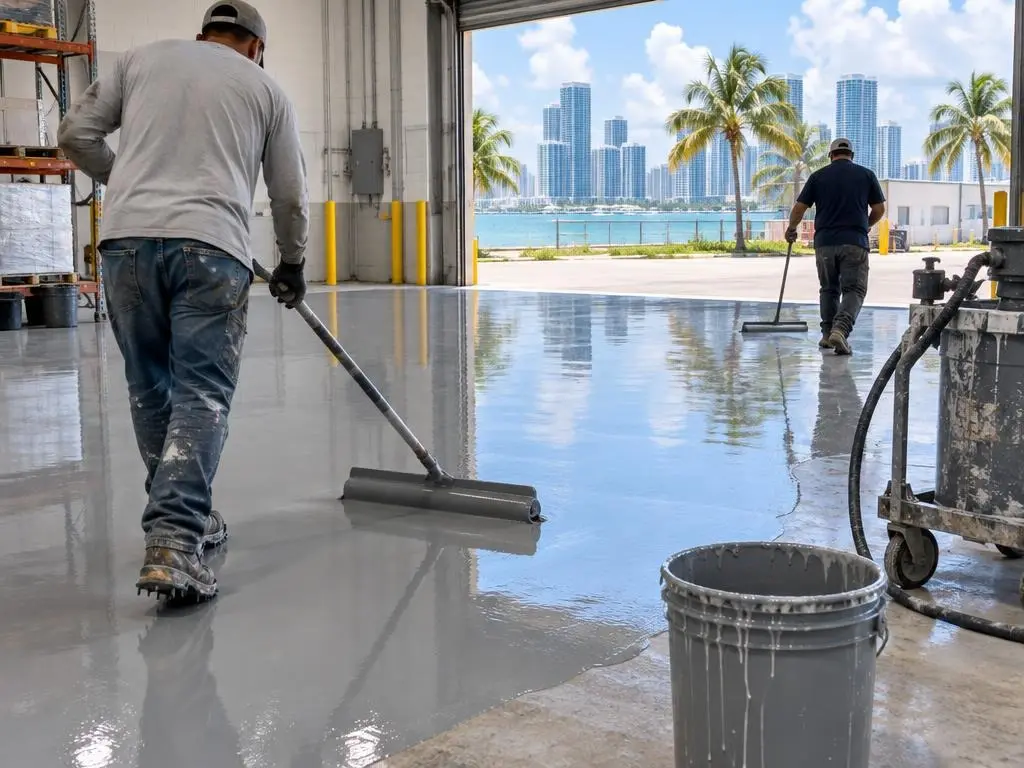
Epoxy Garage Flooring Service Areas
- Epoxy Flooring in Miami, FL
- Epoxy Flooring in Miami Beach, FL
- Epoxy Flooring in Coral Gables, FL
- Epoxy Flooring in Doral, FL
- Epoxy Flooring in Hialeah, FL
- Epoxy Flooring in Miami Lakes, FL
- Epoxy Flooring in Miami Gardens, FL
- Epoxy Flooring in North Miami, FL
- Epoxy Flooring in North Miami Beach, FL
- Epoxy Flooring in Aventura, FL
- Epoxy Flooring in Sunny Isles Beach, FL
- Epoxy Flooring in Key Biscayne, FL
- Epoxy Flooring in South Miami, FL
- Epoxy Flooring in Westchester, FL
- Epoxy Flooring in Sweetwater, FL
- Epoxy Flooring in Fontainebleau, FL
- Epoxy Flooring in Miami Springs, FL
- Epoxy Flooring in Hialeah Gardens, FL
- Epoxy Flooring in Bal Harbour, FL
- Epoxy Flooring in Surfside, FL
- Epoxy Flooring in Coconut Grove, FL
- Epoxy Flooring in Brickell, FL
- Epoxy Flooring in Kendale Lakes, FL
- Epoxy Flooring in Tamiami, FL
- Epoxy Flooring in Miami Shores, FL
Get an Epoxy Garage Flooring Estimate
Free on-site garage estimates across Miami-Dade. Call (786) 321-8267.