
Summer dew points above 70 degrees
Epoxy Flooring in Miami, FL
Floor coatings planned around wet-season air, low ground and a city that is mostly condos and apartments.
- Free estimates done in person, with the floor measured on site
- Every slab moisture-tested before the first coat
- Written quotes that spell out prep, coats and total
Coating Concrete in a Wet, Low City
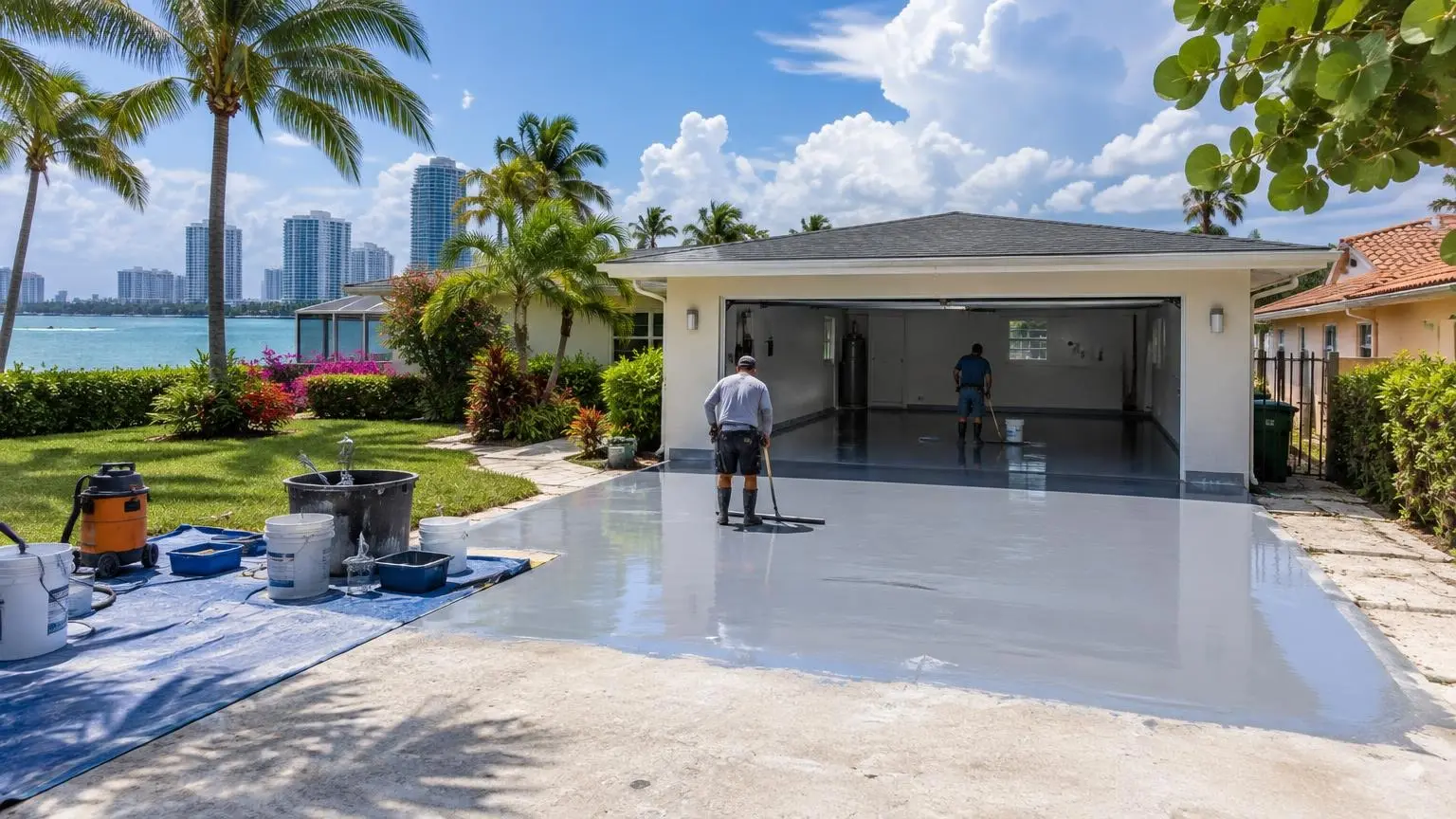
Epoxy flooring in Miami has to be planned around water in the air and water in the ground. From May through October the average dew point sits above 70 degrees, and Wikipedia gives an August average of 73.7. Relative humidity averages 73.2% over the year. A coating that cures well in a dry climate can blush, stay tacky or trap moisture here if it goes down at the wrong hour. We plan every Miami floor around that air.
Why the dew point matters on install day
Resin should not go onto concrete that is close to the dew point. When the slab is only a few degrees warmer than the dew point, a thin film of water can form on the surface and weaken the bond. On a Miami summer day that gap can close fast, especially in a garage that heats up by noon and cools after a storm. We read air temperature, slab temperature and humidity before we mix anything, and we pick the time of day to match.
Thin soil over limestone
The city sits on Miami oolite, a limestone layer covered by thin soil, and most neighborhoods are only about 6 feet above sea level. Wikipedia notes that digging 15 to 20 feet down usually hits water. That high water table is one reason slabs here can push moisture up from below. A calcium chloride or in-slab humidity test shows whether a standard primer is enough or whether a moisture-tolerant primer is the safer choice.
A city of towers and garages
Census figures summarized by Point2Homes show that 40.1% of Miami housing units are in structures with at least 50 units, while only 22.4% are detached houses. That shapes the work we see. Condo boards ask about parking decks, storage rooms and fitness areas. Homeowners in older neighborhoods ask about the garage and the patio. Each one needs a different system and a different schedule.
- Detached houses: flake epoxy finished with polyaspartic for garages and lanais.
- Condo common areas: low-odor systems that can be done in phases.
- Warehouses on the west side: thicker 100% solids epoxy for forklift traffic.
Get a moisture reading and a written price before you decide. Get a free estimate or call (786) 321-8267.
Flood-zone homes
About 40% of Miami homes sit on floodplains, according to Wikipedia. A garage that takes on water once a season needs a coating that can be hosed off and dried without peeling at the edges. We seal the joint where the slab meets the stem wall and keep the coating off cracks that are still moving.
Miami Conditions That Shape a Floor
- High summer dew points. The wet season runs May to October with average dew points above 70 F, peaking at 73.7 F in August.
- Humidity all year. Relative humidity averages 73.2% annually and reaches 77.8% in September, per Wikipedia climate data.
- Water close underground. Miami sits on thin soil over Miami limestone, and digging 15 to 20 feet usually reaches water.
- Mostly large buildings. 40.1% of housing units are in 50+ unit buildings and 22.4% are detached homes (ACS via Point2Homes).
Miami Questions
Can you coat my garage during the Miami rainy season?
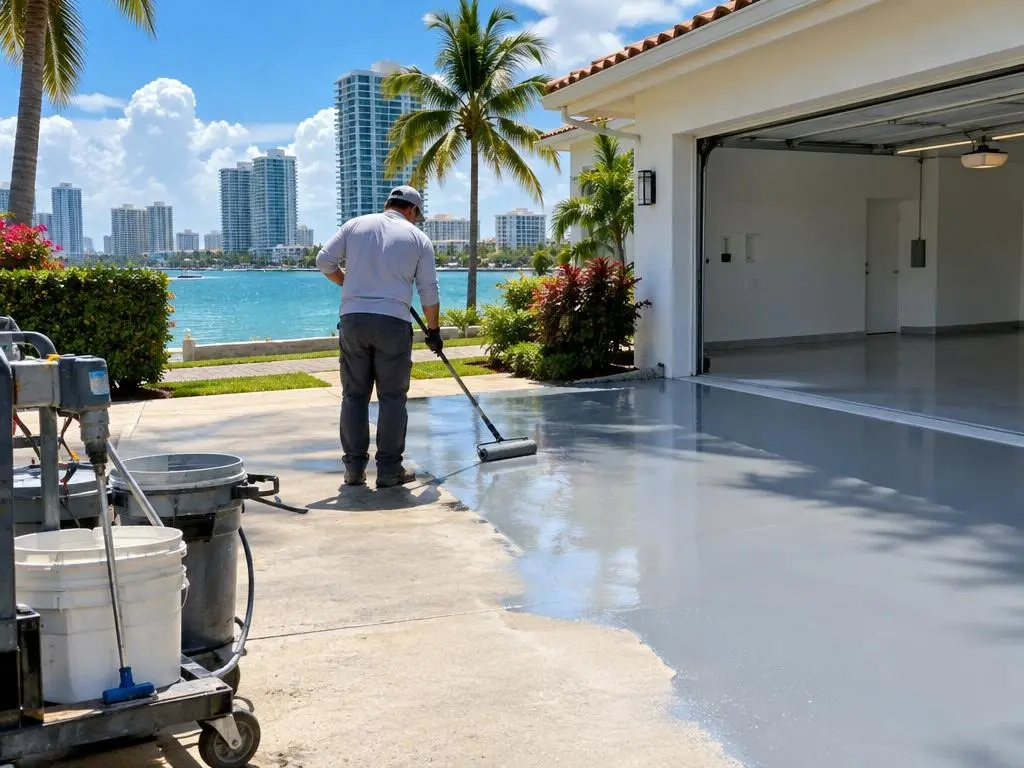
Yes. We plan around the weather and measure dew point and slab temperature on site. If the air is too close to saturation, we wait for a better window instead of risking a cloudy or weak coat.
Does Miami's high water table mean my slab is too wet for epoxy?
Not usually, but it means we test first. If moisture readings come back high, we switch to a primer formulated for damp concrete. A few slabs need drainage fixes before any coating will last, and we will say so.
Can a condo association hire you for a parking area or storage room?
Yes. We can work in sections so residents keep access, and we use lower-odor products where ventilation is limited. We put the plan and price in writing for the board.
Which finish lasts longest in a Miami garage?
For most houses we suggest flake epoxy sealed with polyaspartic. That top layer resists UV yellowing when the door is open, while the flake hides sand and gives traction on a wet floor.
Free Estimates in Miami, FL
From condo common areas to work floors, Miami estimates are free. Call (786) 321-8267.
Epoxy Flooring Near Miami
- Epoxy Flooring in Miami Beach, FL
- Epoxy Flooring in Coral Gables, FL
- Epoxy Flooring in Doral, FL
- Epoxy Flooring in Hialeah, FL
- Epoxy Flooring in Miami Lakes, FL
- Epoxy Flooring in Miami Gardens, FL
- Epoxy Flooring in North Miami, FL
- Epoxy Flooring in North Miami Beach, FL
- Epoxy Flooring in Aventura, FL
- Epoxy Flooring in Sunny Isles Beach, FL
- Epoxy Flooring in Key Biscayne, FL
- Epoxy Flooring in South Miami, FL
- Epoxy Flooring in Westchester, FL
- Epoxy Flooring in Sweetwater, FL
- Epoxy Flooring in Fontainebleau, FL
- Epoxy Flooring in Miami Springs, FL
- Epoxy Flooring in Hialeah Gardens, FL
- Epoxy Flooring in Bal Harbour, FL
- Epoxy Flooring in Surfside, FL
- Epoxy Flooring in Coconut Grove, FL
- Epoxy Flooring in Brickell, FL
- Epoxy Flooring in Kendale Lakes, FL
- Epoxy Flooring in Tamiami, FL
- Epoxy Flooring in Miami Shores, FL