
Garages, terraces, pool decks and warehouses across Miami-Dade
Epoxy Flooring in Miami, FL
Resin floor systems picked for year-round humidity, hard tropical sun and slabs that sit close to the water table.
- Free estimates done in person, with the floor measured on site
- Every slab moisture-tested before the first coat
- Written quotes that spell out prep, coats and total
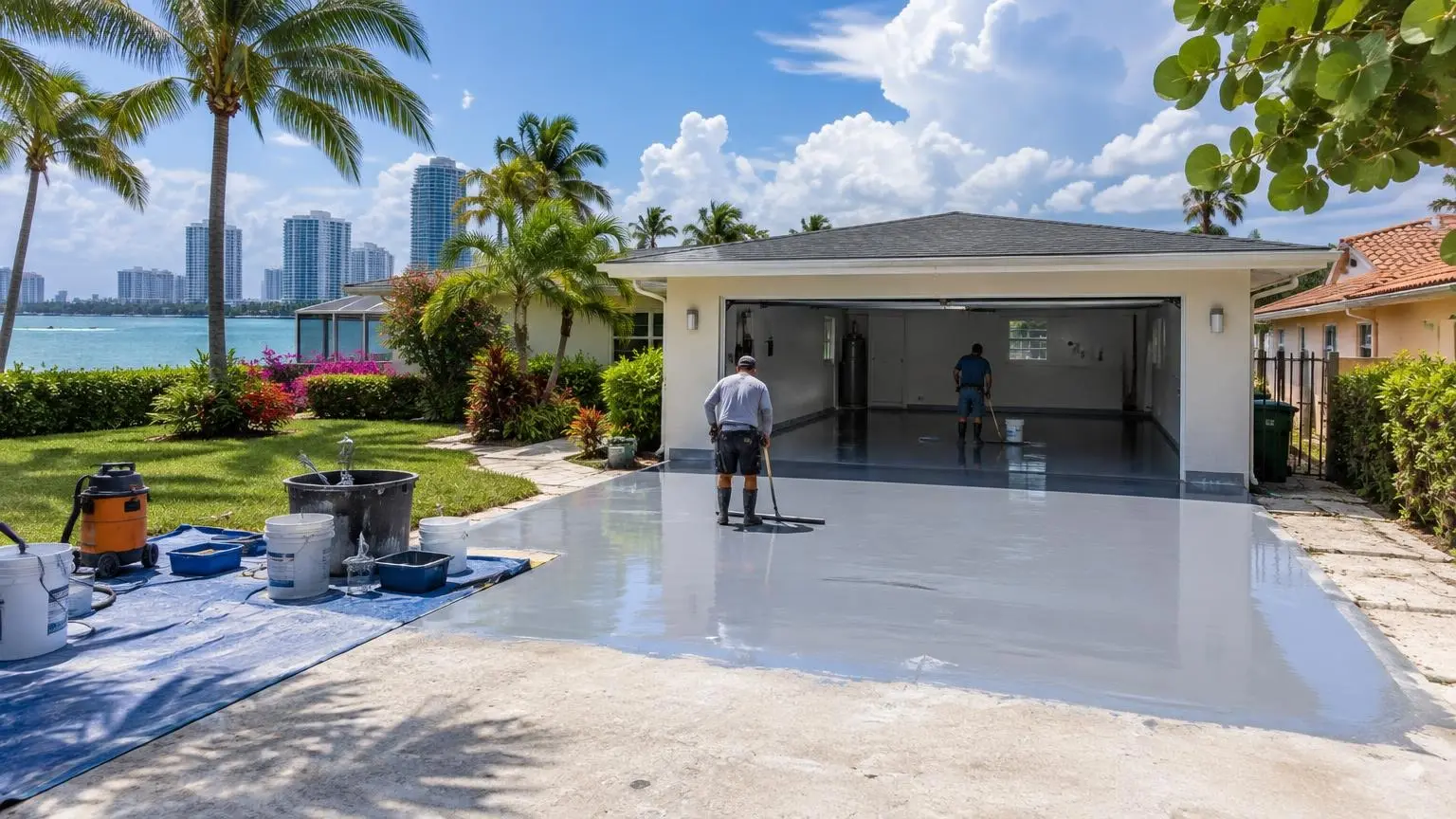
Floor Coatings Made for Miami Conditions
Epoxy flooring in Miami, Florida runs into conditions most coating labels skip over. Relative humidity averages about 73% over the year, the wet season lasts from May through October with dew points above 70 degrees, and the ground is a thin layer of soil over porous limestone, with water often just 15 to 20 feet below. Miami Epoxy Flooring Pros coats garage floors, condo storage rooms, terraces, pool decks, interior slabs and commercial floors throughout Miami-Dade, and we pick every system with that moisture, heat and sun in mind. Get a free estimate
What an epoxy floor coating actually is
An epoxy floor coating is a two-part resin that hardens into a bonded layer on top of concrete. Done right, it seals the slab so oil, pool chemicals, sand, salt water and spilled drinks sit on the surface instead of soaking in. The term gets used loosely. Store kits are usually thin water-based epoxy that rolls on like paint. Professional systems use 100% solids epoxy, which goes on much thicker, often under a polyaspartic or urethane topcoat. HomeGuide lists water-based epoxy as lasting about 3 to 5 years and solid epoxy about 10 to 20 years. The difference you see in a few years comes from the material and, even more, from the prep underneath it.
Why Miami is hard on floor coatings
Three conditions cause most of the coating failures in South Florida.
- Moisture from below. Concrete is porous. Where the soil beneath a slab never fully dries, water vapor travels upward through the concrete. A coating that seals the top can trap that vapor, and the result is blisters, white haze or peeling. Testing the slab before coating tells us which primer to use.
- Humid air during the install. If the slab surface is near the dew point, a thin film of moisture forms on it, and resin applied over that film will not bond well. In Miami summers, that can happen on an ordinary afternoon. We check the readings before each coat.
- Sun and heat. On UV resistance, HomeGuide scores ordinary epoxy only poor to fair. Put it in a garage with the door open, on a lanai or around a pool, and it yellows and chalks. Polyaspartic topcoats get an excellent UV rating from HomeGuide, so we use them by default wherever daylight lands.
Homes, towers and everything between
Miami's housing mix shapes the work. ACS figures summarized by Point2Homes show roughly 40% of housing units in the city are in structures holding 50 or more units, and only about 22% are detached houses. So a big share of our calls are for condo storage rooms, private garages in towers, balconies and rooftop terraces, where building rules, elevator access and odor all matter. The detached homes, especially in older neighborhoods and nearby cities like Hialeah, Miami Springs and Miami Gardens, are often on slabs from the 1950s to 1970s. Those floors have usually been painted or patched at least once, and the old layers have to come off before anything new will stick.
Choosing between epoxy, flake, polyaspartic and metallic
Most homeowners do not need to pick a chemistry. They need to describe how they use the space, and we match the system to it.
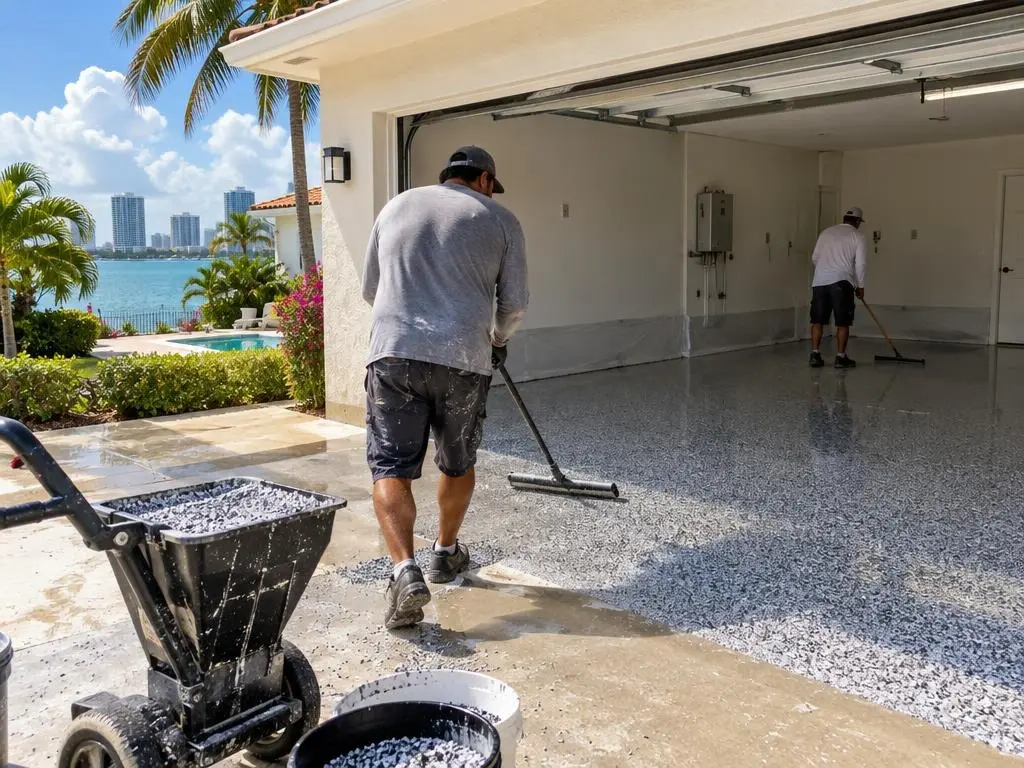
- A daily-driver garage usually gets a flake broadcast floor with a clear polyaspartic topcoat. The chips hide sand and dust and add grip.
- A garage you need back fast may suit a full polyaspartic system. HomeGuide says it can handle vehicle traffic in about 24 to 48 hours, where epoxy may need as long as a week.
- An interior room, studio or display space can take a metallic epoxy floor, which gives a deep, marbled look.
- Warehouses, shops and kitchens need thicker commercial epoxy, sometimes with texture for wet areas.
- Terraces and pool decks need UV-stable, slip-aware outdoor systems, not interior epoxy.
Questions for epoxy flooring contractors in Miami
Miami-Dade has no shortage of epoxy flooring companies, and their quotes tend to look the same until you dig in. Put these questions to anyone you call:
- Will you grind the floor, or only acid etch it?
- Do you test the slab for moisture, and what do you do if it fails?
- What topcoat goes on the part of the floor the sun reaches, and is it UV stable?
- How do you handle humidity and dew point on summer install days?
- How many coats, and how thick is the finished system?
- How soon can I walk on it, reload the shelves and park the car?
- Does the written quote include crack repair, old coating removal and stem walls?
Careful epoxy floor installers answer all of these without stalling. Our quotes spell out those answers in writing.
Epoxy flooring cost in Miami
Price in Miami mostly follows three things: how many square feet you have, what shape the slab is in, and which coating system goes down. Across the country, HomeGuide pegs installed epoxy at $4 to $10 per square foot, or roughly $1,600 to $5,800 on a two-car garage. That guide lists polyaspartic at about $5 to $12 per square foot. Expect the number to rise for grinding off old paint, filling a lot of cracks, a moisture-blocking primer or a metallic finish. Each service page shows published ranges for its type of job. The real price is the one on the written estimate we give you once we have seen the floor.
After the coating goes down
Living with a coated floor is simple, though a few habits stretch its life in this climate. Sweep or blow out sand regularly, because grit under tires slowly wears down any topcoat. Wash away pool chemicals, fertilizer and salt water before they sit. Clean with a pH-neutral product instead of harsh degreasers. When a storm drives water and silt into the garage, hose it out while it is still wet. The coating cannot keep water out of the garage, but it stops the concrete from absorbing it, which makes cleanup faster.
Getting started
Phone (786) 321-8267 or fill in the form to book a visit. We measure, test the slab, ask how the space gets used and leave a written quote behind. Condo owners and HOA residents should mention any approval steps on that first call so the schedule can work around them.
Our Epoxy Flooring Services
Six coating services built around the concrete Miami households and businesses really use: garages, condo and house floors, terraces, pool decks and busy commercial spaces.
Epoxy Garage Flooring
Ground, repaired and sealed garage floors with a UV-stable topcoat, built for sand, hot tires and the sun through the open door.
Learn more →Flake Floor Systems
Full-broadcast vinyl chip floors that disguise sand and dust, improve traction and are sealed with a clear UV-stable topcoat.
Learn more →Polyaspartic Floor Coatings
Fast-curing, UV-stable coatings that do not yellow in the sun, with vehicle traffic in about a day or two.
Learn more →Metallic Epoxy Floors
Hand-worked metallic resin floors with depth and movement for living spaces, studios, retail and garages that double as showpieces.
Learn more →Commercial & Warehouse Epoxy
Thick, chemical-resistant concrete floor coating for warehouses, shops, kitchens, clinics and retail across Miami-Dade.
Learn more →Terrace & Pool Deck Coatings
UV-stable, textured coatings and pool deck resurfacing for patios, lanais, balconies and rooftop terraces.
Learn more →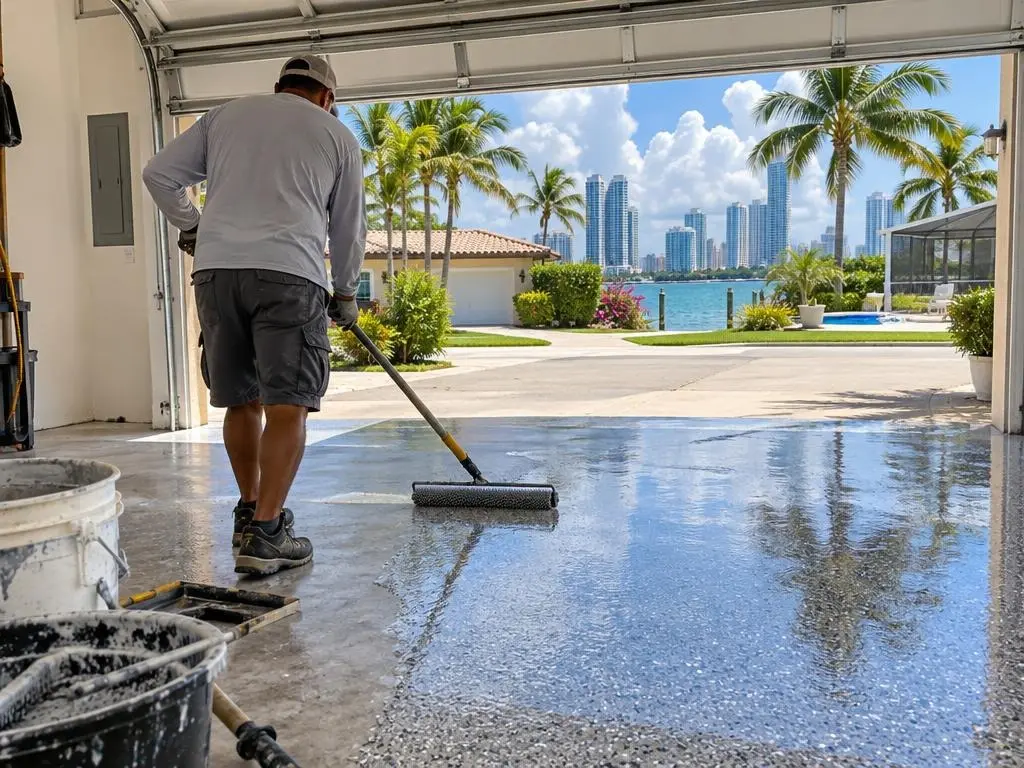
Why Homeowners Call Miami Epoxy Flooring Pros
We test before we quote
Every slab gets a moisture test at the estimate. With ground water this close to the surface, the result decides which primer goes down first.
UV-stable finish wherever light reaches
Where sun hits, such as garage floors near the door, terraces and pool decks, we finish with polyaspartic or a full outdoor system, because plain epoxy yellows in the sun.
We watch the dew point
Air temperature, humidity and slab temperature are read before each coat. On a day when the numbers are wrong, we wait rather than trap moisture.
Building and HOA paperwork planned in
Condo approvals, work hours and elevator bookings are part of the schedule, not something you find out about on install day.
Common Questions
What should I budget for an epoxy floor in Miami?
Nationally, HomeGuide puts installed epoxy at $4 to $10 per square foot. For a 500 square foot floor, that lands near $2,000 to $5,000 before extra prep, and the same guide shows about $1,600 to $5,800 for a two-car garage. Old paint removal, crack repair and flake or metallic finishes push the total up, which is why we only price a floor once we have seen it.
Does epoxy flooring have drawbacks?
It does. Epoxy wants a clean, dry, properly ground slab, and trapped moisture or oil under it leads to blisters or peeling. HomeGuide says standard epoxy may need as long as a week to cure fully and gives it a poor to fair UV rating, so sun can yellow it. A glossy surface can also get slippery when wet. Grinding, a moisture test, texture in the finish and a topcoat that holds up to UV address each one.
What is a better floor coating than epoxy?
It depends on the floor. For sunny garages and outdoor surfaces, polyaspartic is often the better choice because it earns an excellent UV resistance rating from HomeGuide and cures in about a day or two. Epoxy is still a strong, thick base coat and works well indoors. Many of our systems combine the two: epoxy underneath for build, polyaspartic on top for sun resistance.
Can you put epoxy on a floor that gets damp?
Sometimes. If the moisture test shows vapor coming up through the slab, we use a primer made for that condition before the main coats. If water is actually entering the space, such as through a door threshold or a crack during storms, that has to be solved first, because no coating will hold back standing water.
Do condo buildings in Miami allow epoxy work?
Many do, but most require approval first. Buildings often set work hours, want the elevator booked and pads installed, and may ask for paperwork before a crew arrives. Share your building's rules up front and we will build the schedule to fit them.
Is outdoor epoxy a good idea for a Miami patio or pool deck?
Standard interior epoxy is not, because the sun breaks it down. Outdoor concrete needs a UV-stable system, usually polyaspartic or an epoxy base with a UV-stable topcoat, plus texture so it is safe when wet. Our Terrace & Pool Deck Coatings page goes into the options.
When can I drive onto my newly coated garage floor?
That depends on the system and the weather. According to HomeGuide, polyaspartic needs about 24 to 48 hours until it can take heavy vehicles, while epoxy should go 2 to 7 days without cars on it. Before we leave, you get the exact times for your floor.
Neighborhoods and Cities We Cover
We work across the City of Miami, including Brickell, Coconut Grove and the neighborhoods around downtown, and throughout Miami-Dade County. That includes Miami Beach, Surfside, Bal Harbour, Sunny Isles Beach and Key Biscayne on the barrier islands; Aventura, North Miami, North Miami Beach and Miami Shores to the north; Coral Gables and South Miami to the south; and Doral, Hialeah, Hialeah Gardens, Miami Springs, Miami Lakes, Miami Gardens, Sweetwater, Fontainebleau, Westchester, Tamiami and Kendale Lakes to the west. The conditions vary a lot. Island homes and towers sit only a few feet above sea level and deal with salt air and storm water. Older inland neighborhoods tend to have mid-century slabs that have been painted and patched. Doral and the areas near the airport have a large stock of warehouses and flex space. Every city page below goes into the local housing and the slabs we tend to find there.
- Epoxy Flooring in Miami, FL
- Epoxy Flooring in Miami Beach, FL
- Epoxy Flooring in Coral Gables, FL
- Epoxy Flooring in Doral, FL
- Epoxy Flooring in Hialeah, FL
- Epoxy Flooring in Miami Lakes, FL
- Epoxy Flooring in Miami Gardens, FL
- Epoxy Flooring in North Miami, FL
- Epoxy Flooring in North Miami Beach, FL
- Epoxy Flooring in Aventura, FL
- Epoxy Flooring in Sunny Isles Beach, FL
- Epoxy Flooring in Key Biscayne, FL
- Epoxy Flooring in South Miami, FL
- Epoxy Flooring in Westchester, FL
- Epoxy Flooring in Sweetwater, FL
- Epoxy Flooring in Fontainebleau, FL
- Epoxy Flooring in Miami Springs, FL
- Epoxy Flooring in Hialeah Gardens, FL
- Epoxy Flooring in Bal Harbour, FL
- Epoxy Flooring in Surfside, FL
- Epoxy Flooring in Coconut Grove, FL
- Epoxy Flooring in Brickell, FL
- Epoxy Flooring in Kendale Lakes, FL
- Epoxy Flooring in Tamiami, FL
- Epoxy Flooring in Miami Shores, FL
Book a Free Floor Coating Estimate
One visit: measurements, a moisture reading and a written quote. Call (786) 321-8267.